

The Insurer Nobody Plans On
Nobody shops for Citizens. You end up there. A carrier pulls out of Florida, a renewal arrives with a number that reads like a typo, or an underwriter looks at a 1978 Palm Bay ranch with its original panel and quietly declines. Then your agent says the word Citizens, and it sounds like a downgrade.
It isn't, exactly. Citizens Property Insurance Corporation is a not-for-profit entity created by the Florida Legislature to be the state's residual market, the place that writes a policy when the private market won't at a comparable price. It is a backstop, not a competitor. That single fact explains almost everything else about how it behaves, including the parts homeowners find frustrating.
Because it is a backstop, it is not designed to keep you. It is designed to hold you until the private market can take you back. And because its exposure is backed by Florida policyholders at large, it is unusually particular about what it will accept, which is where inspections enter the story.
What we are: Florida-licensed inspectors. We complete the forms and document what the home actually has. We do not sell policies, adjust claims, decide eligibility, or promise what a carrier will do with a report. When this post says a premium may change, that word is doing real work.
The 20 Percent Rule, Running Both Directions
The single most useful thing to understand about Citizens is a threshold that governs both getting in and getting out: 20 percent.
To be eligible for Citizens in the first place, you generally have to be unable to obtain comparable coverage from an admitted private carrier, or be facing a private premium more than 20 percent higher than what Citizens would charge. If the private market will cover you for a reasonably similar number, that is where you belong.
The same threshold then works in reverse, and this is the part that surprises people. Through the state's depopulation program, private carriers approved by the Florida Office of Insurance Regulation can select Citizens policies and offer to assume them. If an approved carrier offers comparable coverage within 20 percent of Citizens' estimated renewal premium, you become ineligible to stay. The offer isn't really an offer in the everyday sense. It is a notice that you have graduated.
You'll hear this called a "takeout." Homeowners who ignore the packet, assuming it's junk mail, sometimes discover at renewal that they were moved anyway. If a takeout packet lands on your table, read it and talk to your agent that week. Citizens publishes its own depopulation resources explaining the mechanics.
Three Inspections, Three Entirely Different Jobs
Here is where homeowners get tangled, and it is worth being precise, because these three documents get discussed as if they were interchangeable and they are not. One decides whether you can be insured. One decides whether your roof is acceptable. One may affect what you pay. Different forms, different triggers, different consequences.
1. The Four-Point: Can You Be Insured At All
Citizens requires a four-point inspection on personal residential multiperil applications for homes more than 20 years old. That is a lower threshold than many private carriers use, which is why plenty of Brevard homeowners encounter their first four-point when they move to Citizens rather than before.
The scope is the same four systems it has always been (roof, electrical, plumbing, and HVAC), and we've covered what each of those four sections actually looks at in detail elsewhere. The Citizens-specific wrinkle is the form itself. Citizens publishes its own four-point form and revises it periodically. Submitting last year's version, or a generic form from another carrier, is a common and entirely avoidable way to lose a week while underwriting asks for it again.
There is no pass or fail printed anywhere on it. It is a condition report. Underwriting reads it and decides. What tends to stop an application cold is not age but specific conditions: an active leak, a federal-pacific-style panel with known hazards, polybutylene supply lines, or a water heater well past its service life. If you want to know what we look at and how to have the house ready, our 4-point preparation guide covers it.
2. The Roof Inspection: The Five-Year Question
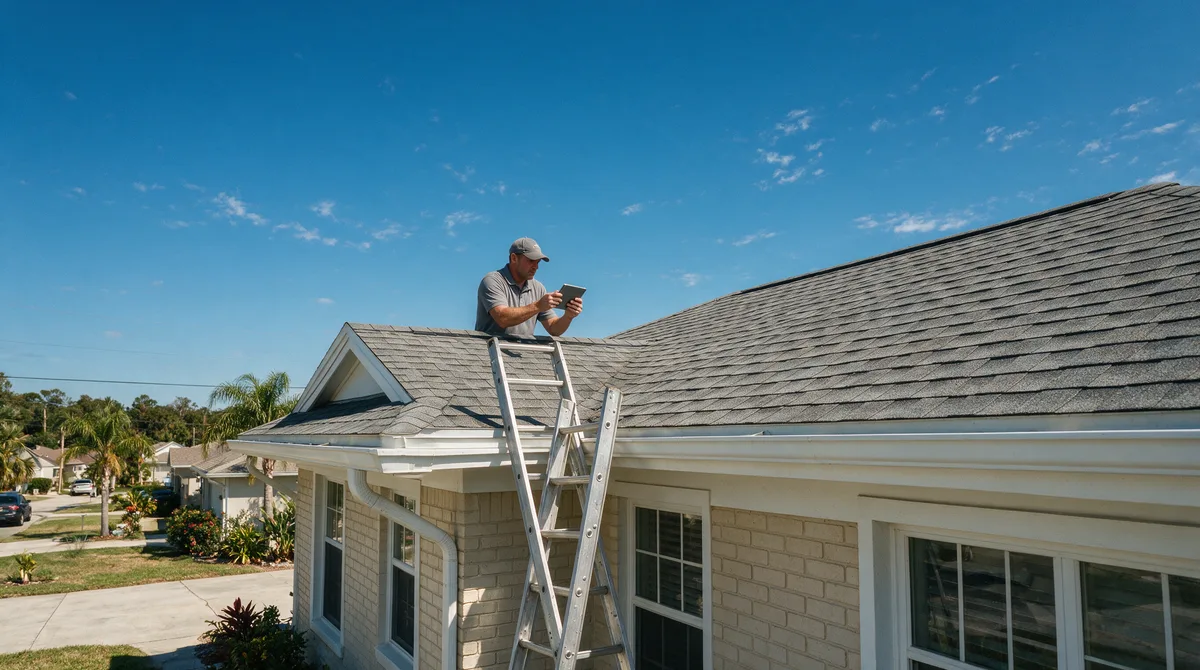
Roof age is the item that ends the most Citizens applications, and the rule is refreshingly concrete for once. Once a soft covering such as asphalt shingle passes 25 years, or a hard covering such as tile, slate, concrete or metal passes 50 years, Citizens wants documentation showing the roof has at least five years of remaining useful life.
Read that carefully, because it is better news than most homeowners assume. A 27-year-old shingle roof is not automatically disqualified. It needs a Florida-licensed inspector to look at it and document that it has five years left. Sometimes it does. Often, in Brevard, it does not. Our sun and our storms are hard on roofs, and we've written about why Florida roofs age faster than the warranty suggests. But the finding is a judgment about condition, not arithmetic about the install date.
One detail worth flagging: the inspector's Florida license has to be active and verifiable. Citizens says plainly that a form may not be accepted if the appropriate professional did not perform the inspection or the license cannot be verified. Ours is HI 11755, and our inspectors also hold general contractor CGC1530959 and roofing contractor CCC1336594, which is a large part of why our roof certification inspections tend to survive underwriting review.
3. Wind Mitigation: The Only One That Can Reduce the Bill
The first two documents are about whether Citizens will write the policy. Wind mitigation is the one that can affect what the policy costs. It uses the state's uniform form, OIR-B1-1802, which is the same document for every carrier in Florida. Citizens has no special version of it.
The inspection documents construction features that resist wind: roof covering and its compliance date, roof deck attachment, roof-to-wall connection, roof geometry, secondary water resistance, and opening protection. If your home has them, the report says so, and the carrier applies whatever credits its filed rates provide. If it doesn't have them, the report says that too. We do not decide the credit, and we do not know its size in advance. Premiums may be reduced. Anyone who tells you by how much before the inspection is guessing.
What makes this worth doing anyway is the asymmetry: a wind mitigation inspection is $125 standalone, it's free with any full home inspection right now, and the form stays valid for five years. Our guide to which features carry the most weight goes through them one by one.
The Flood Requirement People Keep Missing
This one catches buyers mid-closing, so it deserves its own heading. Florida law now requires most Citizens personal residential policyholders with wind coverage to carry separate flood insurance, phased in over several years by dwelling replacement cost, with higher-value structures first, the remainder following. Policies that do not include the peril of wind are excluded.
Flood is a separate policy from a separate source, it is not part of your Citizens premium, and "my house is not in a flood zone" does not exempt you if the requirement applies to your policy. It is not an inspection item and we have nothing to sell you here. We mention it only because we watch it derail closings that were otherwise clean. Ask your agent which phase your policy falls into, and ask early.
How This Usually Plays Out in Brevard
A practical sequence, drawn from what actually walks through our door:
- Non-renewal or a brutal quote arrives; agent mentions Citizens
- Home is over 20 years old, so a four-point is requested
- Roof is over 25 years, so roof documentation is requested too
- Wind mitigation gets added because it is the only one that can help the price
- All three are completed in a single visit
- Reports go to the agent; underwriting decides
That last-but-one line is the practical tip. These are three separate documents, but they are not three separate trips. We schedule them together, and if you are also buying the home, the whole set folds into a full home inspection in one appointment. The four-point and wind mitigation combination is $250, and wind mitigation is included free with any full home inspection. Current numbers are all on our rates page.
What We Will and Will Not Tell You
We will tell you exactly what the home has, photograph every finding, complete the current forms correctly, and get the report to your agent within 24 hours, usually the same day. If the roof has five good years in it, we will document five good years. If it doesn't, we will say so, and you will at least have found out on a Tuesday rather than eleven days before closing.
We will not tell you a carrier will accept you, predict a premium, complete a form to say something the house does not support, or advise you on which policy to buy. Those are an agent's job, an underwriter's job, and in one case nobody's job at all. Eligibility rules and inspection thresholds also change. Citizens revises both, sometimes more than once a year. The current requirements always live on Citizens' own inspections page, and statewide filings are public at the Florida Office of Insurance Regulation. Check them, or ask your agent to. Do not take a blog post's word for a threshold that decides your coverage, including this one.
Frequently Asked Questions
Need Citizens Paperwork Done Right the First Time
Four-point, roof documentation and wind mitigation completed in a single visit on the current forms, by a Florida-licensed inspector. 4-point $150, wind mitigation $125, both for $250. Full home inspections from $299 with wind mitigation included free. Same or next-day scheduling across Brevard County.