
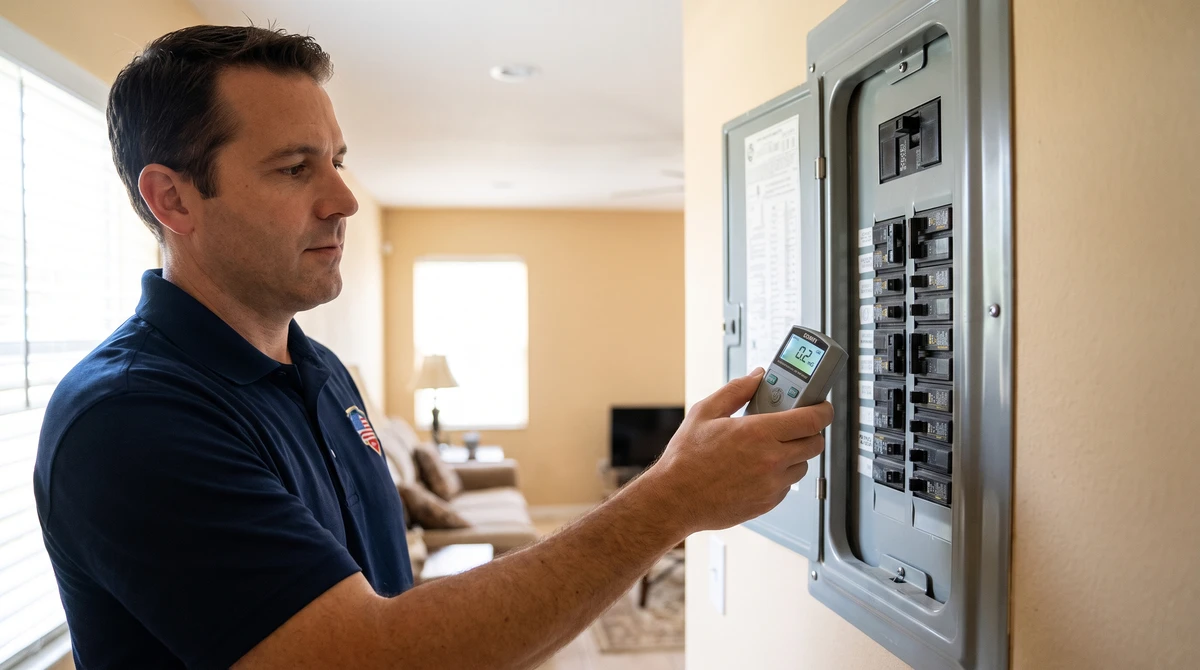
A buyer asked me last spring whether the house she was under contract on had "high EMF," because a forum post told her to ask. She had no idea what she was asking for, and neither did her agent. That is the normal state of this conversation, and it is fixable in about four paragraphs.
Three Different Things Wearing One Name
EMF is the umbrella. Underneath it sit measurements that behave so differently from each other that treating them as one number is the whole problem.
EF, the electric field. Measured in volts per meter. It exists any time a conductor is energized, whether or not a single electron is moving through it. Your bedroom wall has an electric field around the wiring in it right now, with every light in the house switched off. The useful thing about EF is that almost anything blocks it. Drywall attenuates it, a grounded surface kills it, and a person standing in the room distorts it just by being there.
MF, the magnetic field. Measured in milligauss in the United States, or microtesla everywhere else, at the 60 Hz frequency the grid runs on. A magnetic field only appears when current is actually flowing. Turn the dryer on and the field around its feed climbs. Turn it off and the field collapses. Here is the part that matters: nothing in ordinary residential construction stops it. It goes through drywall, through wood framing, through concrete block, through the tile roof, and through you. Shielding a magnetic field takes specialized alloy, not a layer of foil from the hardware store.
That asymmetry is the reason a competent test starts with the magnetic field. One of these two you can fix by moving a bed three feet. The other one follows you.
RF, radiofrequency. A different animal entirely, up in the range from roughly 100 kHz to 300 GHz. This is the wireless band: the Wi-Fi router at 2.4 and 5 GHz, cell phones and the tower down Wickham Road, the cordless phone base station, Bluetooth, the smart meter on the exterior wall, and, in a Brevard townhouse or condo, four of your neighbors' networks arriving through a shared wall. RF is the one homeowners assume they are asking about. It is usually not the one that produces a surprising reading.
What the Evidence Actually Supports
You deserve the real version rather than either sales pitch. The World Health Organization's International Agency for Research on Cancer classified extremely low frequency magnetic fields as Group 2B, possibly carcinogenic to humans, in 2002. It gave radiofrequency electromagnetic fields the same Group 2B classification in May 2011. Both classifications came from epidemiology showing a statistical association that researchers could not fully explain and could not fully dismiss.
Group 2B is a wide bucket. Aloe vera extract and pickled vegetables are in it. The classification means the evidence is limited, not that harm is established, and anyone who quotes it at you as proof of danger is overselling. The residential studies behind the ELF classification looked at long-term average exposures above roughly 0.3 to 0.4 microtesla, which is 3 to 4 milligauss. Most Florida houses, measured in the middle of a room away from appliances, sit well below 1 milligauss.
On the regulatory side the picture is lopsided. The FCC sets and enforces RF exposure limits for transmitters under 47 CFR 1.1310. For 60 Hz magnetic fields inside a residence there is no federal exposure limit in the United States at all. No number to pass or fail. That vacuum is exactly why the topic attracts both dismissiveness and hysteria, and why a measured reading is worth more than either.
Where we stand: we are licensed inspectors, not physicians and not remediation contractors. We measure, we document the readings with their locations, and we tell you what the numbers mean electrically. We do not diagnose symptoms, we do not sell shielding products, and we do not tell you what a reading means for your health. That conversation belongs to you and your doctor.
The Argument That Does Not Depend on the Health Debate
Set the epidemiology aside completely. Here is why I think this test earns its place on an inspection.
In a correctly wired circuit, the current leaving on the hot conductor and returning on the neutral are equal and opposite, and their magnetic fields cancel almost perfectly. Net current is close to zero and so is the field a few inches away. When a meter reads a steady elevated magnetic field in a hallway or a bedroom, with no appliance running, that cancellation has failed somewhere. Current is going out on one path and coming back on another.
The usual culprits are boring and specific. A shared neutral serving two circuits that were split across different phases. A neutral bonded to ground in a subpanel instead of only at the main service. A wiring error in a remodel where a neutral got picked up from the wrong circuit. Return current riding on copper water piping because a bond somewhere gave it a parallel path.
NEC 250.6 has a name for that last category. Objectionable current.
Every one of those is a genuine defect that belongs in an inspection report on its own merits, with no reference to cancer risk whatsoever. Current returning on a water pipe means a plumbing repair can interrupt a grounding path. A neutral-ground bond in a subpanel means fault current has a route it was never designed to take. These are safety findings, and a magnetic field survey is a fast, non-invasive way to spot them from the middle of a room. That is the practical case for the test, and it is the one I make to buyers who ask.
Where the Readings Come From
- Wiring errors producing net current on a circuit
- The service drop, meter base, and main panel
- A subpanel with an improper neutral-ground bond
- Return current on copper water piping
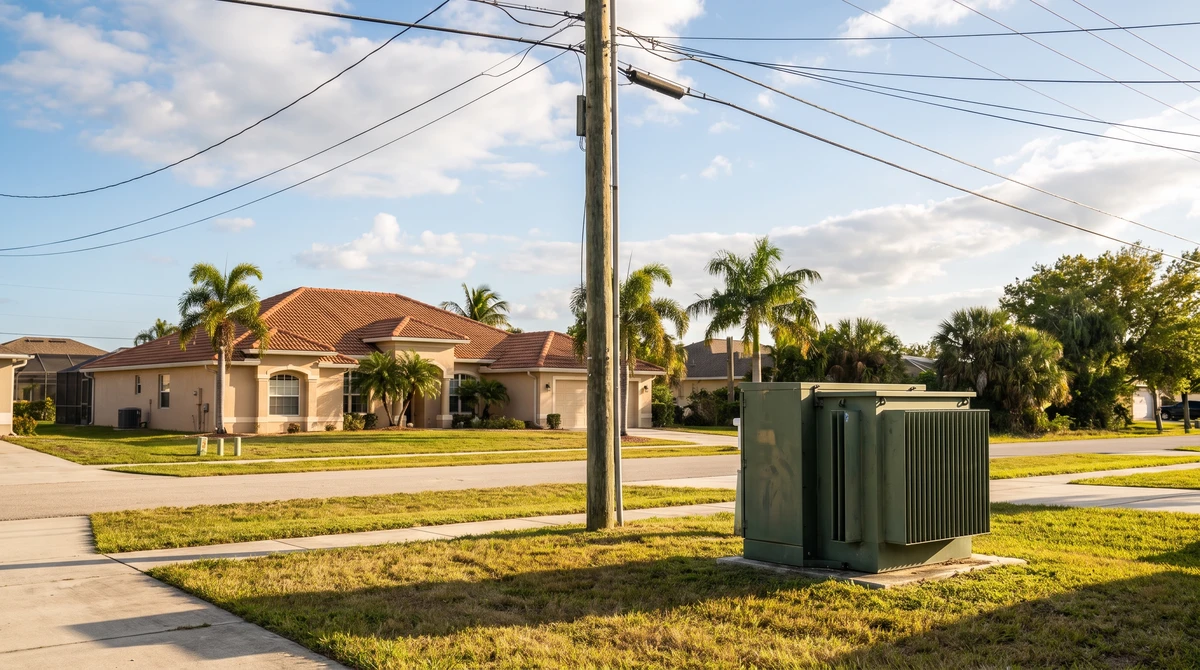
- Pad-mounted or pole-mounted utility transformers near the lot line
- Pool pumps, well pumps, and their dedicated feeds
- Older knob-and-tube runs where hot and neutral are separated
- Dimmer switches and variable-speed motor drives
- Wi-Fi routers, mesh nodes, and cordless phone bases
- Smart meters and neighboring units in attached construction
Distance does most of the work on the point sources. Magnetic fields from a panel or a transformer fall off steeply, which is why a reading of 40 milligauss six inches from a panel and under 1 milligauss at the far side of the same wall is completely ordinary rather than alarming. It also explains the single most common piece of useful advice this test produces, which costs nothing: move the bed, move the desk, move the crib to the other wall.
What the Test Includes
We walk the house with calibrated meters and take magnetic field, electric field, and RF readings room by room, with particular attention to the places people spend eight hours at a stretch. Beds, desks, cribs, and reading chairs. We take a set of readings at the electrical panel and any subpanels, at the meter base, along the service entrance, and at the property line where the utility equipment sits. RF gets logged at the router, at the smart meter, and at the exterior walls that face a neighbor or a tower. Every number goes in the report with the location and the conditions it was taken under, because a milligauss reading with no context is just a number.
If a reading points at a wiring fault, that becomes a finding in the report the same way a double-tapped breaker does, with a recommendation to have a licensed electrician evaluate it. If everything reads low, you get that in writing too, which is genuinely the more common outcome and worth having when a seller or a buyer has been told otherwise.
The service is $150 on its own, or $75 added to a full home inspection, which is the way almost everyone books it. You can add it yourself on the instant quote tool, alongside a 4-point inspection or the wind mitigation report that comes free with every full inspection. If you would rather talk it through first, reach us here or call the office.
Frequently Asked Questions
Add EMF and RF Testing to Your Inspection
EMF and RF testing is $150 standalone or $75 added to a full home inspection. Full inspections start at $299 and include a FREE wind mitigation report. Same or next-day scheduling across Brevard County.