
Two Roofs, Same Birthday
Two houses off Wickham Road. Both re-roofed the same year with the same architectural shingle. One faces north under a canopy of live oaks. The other sits wide open to the west with nothing between it and eleven hours of sun a day.
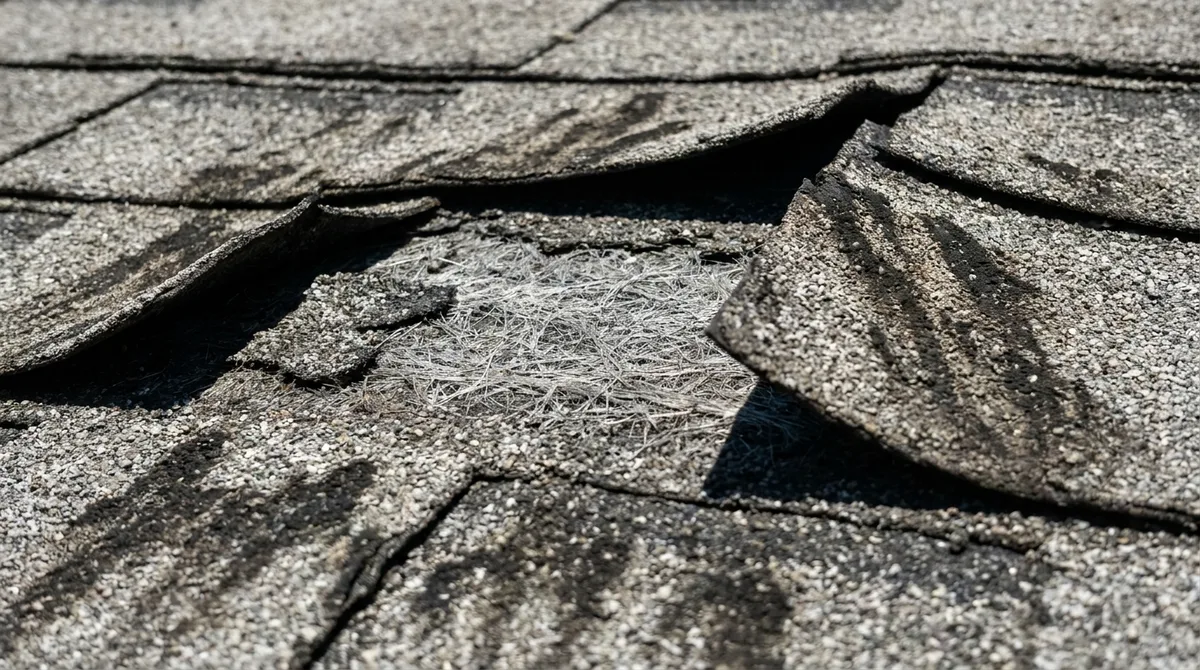
Twelve years later they are not the same roof. The shaded one still has granules where granules belong. The exposed one is chalky, curling at the edges of the south slope, and losing its mat. Same product, same installer, same install date, completely different answer when a carrier asks how much life is left.
Insurers work from the install date because it's the number they can pull off a form. Inspectors work from what's actually up there. When those two disagree, the inspection is what your policy ends up hanging on.
Why Florida Eats Roofs
Asphalt shingles don't wear out mechanically so much as they age chemically. Ultraviolet light breaks down the asphalt binder, the granules that shield it come loose, and once the mat is exposed the process accelerates. Brevard County stacks the deck:
- Year-round UV load with no real winter break
- Daily summer thermal cycling, hot to cooled by afternoon storms
- Humidity that keeps organic growth alive on north slopes
- Salt air, worse the closer you sit to the Banana River or the beachside
- Wind-driven rain that finds any flashing weakness
- Debris and shade from oaks and pines that hold moisture
None of that is exotic. It just means a shingle rated for a long service life somewhere temperate does not get that life here, and pretending otherwise sets homeowners up for a surprise at renewal.
The Number That Matters: Remaining Useful Life
On a 4-point inspection, one of the most consequential lines is remaining useful life on the roof. It is an inspector's judgment, and it is not a restatement of the install date.
What moves that number:
- Granule loss and exposed fiberglass mat
- Curling, cupping, or lifted tabs
- Soft or spongy decking underfoot
- Nail pops and exposed fasteners
- Failed sealant at penetrations and valleys
- Prior patch repairs, especially mismatched ones
- Staining or active leaks visible from the attic side
- Ponding or ridging on low-slope sections
This is why we go up. You cannot judge remaining life from the driveway with binoculars, and you certainly cannot judge decking condition without walking it and getting into the attic underneath. A roof that photographs fine from the street can feel wrong the moment you step on it.
What Carriers Do With It
Thresholds vary by company and they move. We are not going to publish a number and pretend it applies to your policy. What we consistently see is that once an asphalt roof in Brevard gets into its middle teens, the questions get sharper: underwriters want the 4-point, sometimes a separate roof certification, and occasionally a commitment to replace within a set window as a condition of binding.
Tile and metal generally buy more runway than architectural shingle, and shingle generally buys more than a worn three-tab. But the covering type only sets the range. Condition decides where in that range your house lands.
The practical takeaway: if you are shopping carriers or approaching renewal on a roof in its teens, get the inspection before the conversation rather than after. Walking in with current documentation is a different negotiation than being asked for it under a deadline.
New Roof? Two Jobs, Not One
A replacement solves the insurability problem. It does not automatically solve the pricing problem.
When a roof goes on under current code, several answers on the wind mitigation form can change together: the covering becomes permitted and compliant, the deck attachment comes up to current nailing standards, and secondary water resistance may now be present. Those are credit-bearing items. They are worth nothing to you until they are documented on the OIR-B1-1802 and delivered to your carrier.
Nothing flows from the permit office to your insurer. If your carrier is working from a wind mitigation form completed before the re-roof, the most valuable thing about your house is invisible to them. Our combined 4-point and wind mitigation visit is $250, or the wind mitigation is included free with any full home inspection. Standalone, it's $125.
Selling With an Older Roof
Sellers ask whether to replace before listing. Our honest answer is that it depends on what's actually up there, which is the whole point of looking first.
If the roof is finished, buyers find out and their carrier prices it in, usually less generously than you would have. If the roof has real service life left, a current roof certification and wind mitigation form are frequently worth more in the transaction than a replacement you didn't need to fund. A pre-sale inspection is the cheapest way to know which situation you're in before you commit twenty thousand dollars to the wrong one.
What We Don't Do
We don't sell roofs. Our inspectors hold a Florida Roofing Contractor license (CCC1336594) alongside the home inspector and general contractor licenses, which means we know what correct installation looks like — but SureHome's role on your house is to assess and document, not to bid the work. When we tell you a roof has four years left, no one here profits from that answer.
We also can't promise a premium outcome. Documentation may reduce what you pay; your carrier decides by how much.
Frequently Asked Questions
Find Out What Your Roof Has Left
Roof certifications, 4-point inspections at $150, and wind mitigation at $125 - or both together for $250. Same or next-day scheduling across Brevard County.