
It Starts Before the Ladder Comes Off the Truck
The first useful minutes of a roof inspection are spent standing in the yard doing nothing but looking. Where does the roof drain? Which slope takes the afternoon sun? Are the ridge lines straight, or is there a dip that suggests something structural underneath? Are there oaks overhanging the north side that will keep it damp and shaded year-round?
You also learn a lot from the ground about things that are not the roof but end up on the roof report anyway — gutters pulling away from fascia, soffit panels sagging, staining running down a stucco wall below a valley. Those are symptoms, and knowing where they are tells you where to look hard once you are up there.
Then the ladder goes up.
On the Roof: What Gets Walked and Why
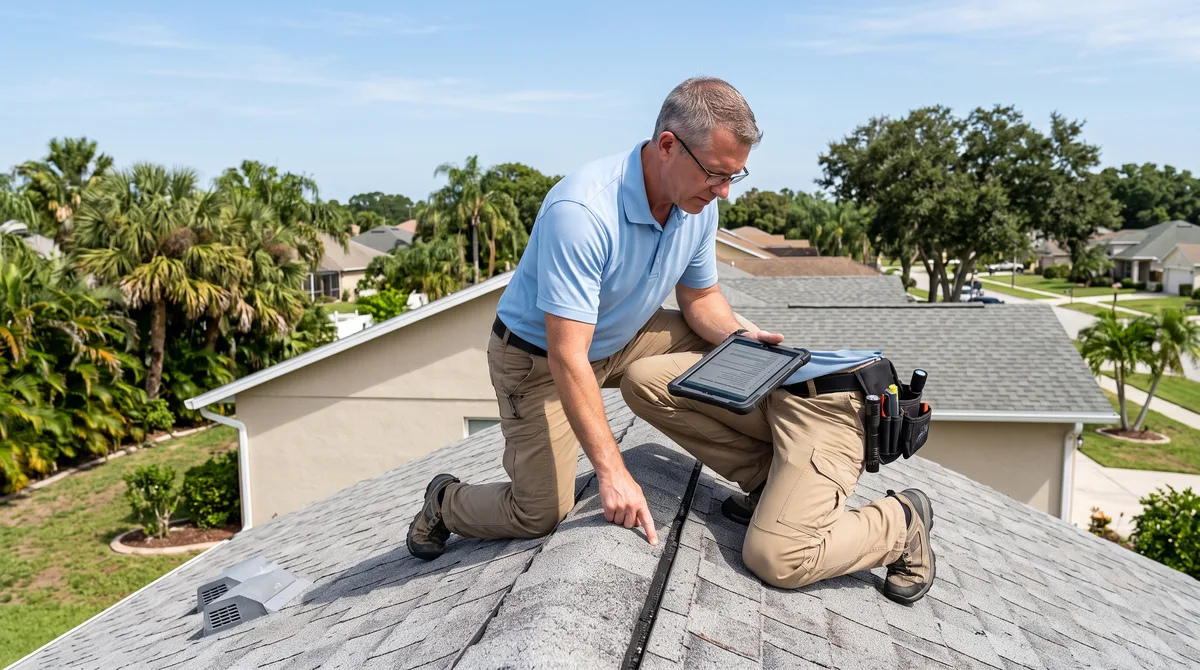
We walk the roof when it is safe to do so and the covering can take the weight. That is not a formality. You cannot feel soft decking through a zoom lens, and a roof that photographs perfectly from the street can go spongy under your boot at the third step.
What gets examined by hand and by camera:
- Covering condition across every slope, not a representative sample
- Granule loss, curling, cupping, cracking and lifted tabs
- Decking feel underfoot — soft spots, deflection between trusses
- Flashing at valleys, walls, chimneys and skylights
- Every penetration: vents, stacks, jacks, satellite mounts, solar standoffs
- Sealant condition, especially where someone has re-sealed before
- Exposed or backed-out fasteners and nail pops
- Ridge and hip cap condition
- Prior repairs, patches and mismatched material
- Drip edge, eave and rake terminations
- Low-slope sections for ponding, ridging or seam failure
- Debris and organic growth holding moisture on shaded slopes
Penetrations deserve their own sentence. In our experience, the roof covering itself is rarely the first thing to leak on a Brevard County home. The failure starts at something that goes through the roof — a plumbing vent boot cracked by fifteen years of UV, a satellite mount someone screwed down without flashing it, a skylight curb that was never sealed properly. The field of shingles is usually the last part to give up.
When we do not walk it: steep pitch, brittle or wet tile, or a covering already deteriorated enough that walking it would cause damage. In those cases we work from the eave and use elevated photography. The report states which method was used, because a roof assessed from a ladder cannot claim everything a walked roof can, and pretending otherwise would be dishonest.
The Half Nobody Photographs: The Attic
This is where a roof inspection separates itself from a look at a roof.
From the top side you see the system that is supposed to keep water out. From the attic you see the evidence of whether it actually has been. Those are different questions, and the second one is the one that matters.
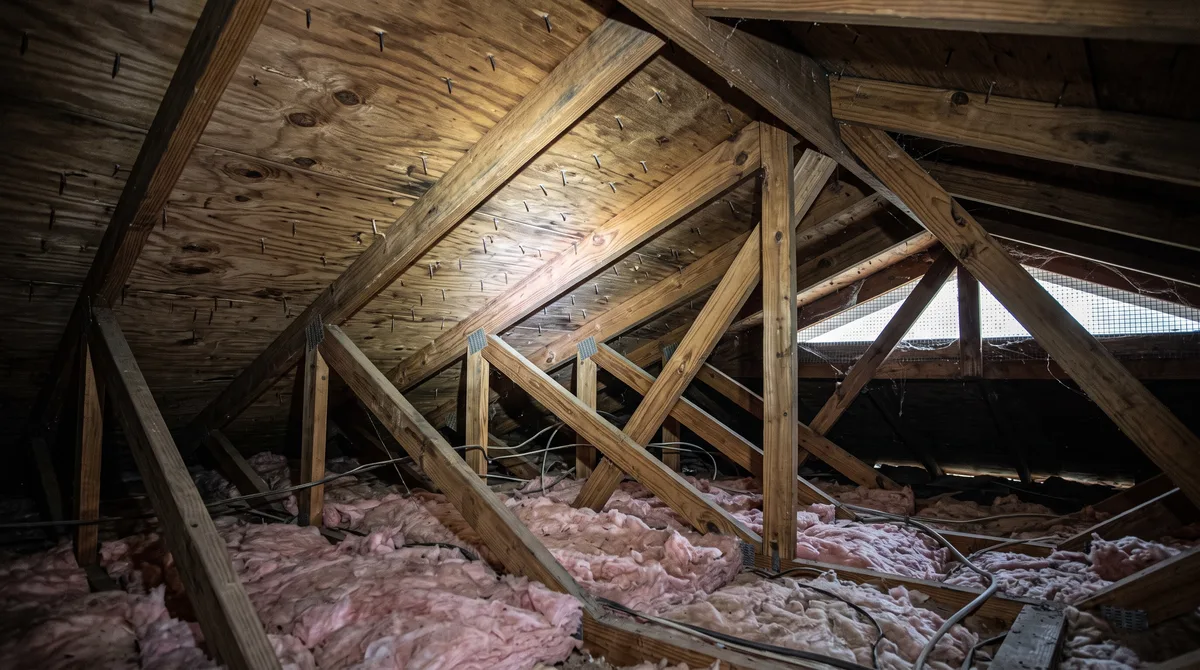
Under there we are looking for:
- Staining on the underside of the decking, active or historic
- Delamination or darkening of the plywood or OSB
- Rusted or dripping nail points, a moisture signature
- Daylight visible through the deck or at penetrations
- Truss and rafter condition, cracks, prior modifications
- Truss-to-wall connections and hurricane strapping
- Insulation that is wet, compressed or displaced by air movement
- Ventilation actually functioning — soffit intake not blocked by insulation
- Bath and dryer vents terminating outside rather than into the attic
- Evidence of prior repairs from beneath
Attic ventilation is the quiet one on that list. A Florida attic that cannot breathe runs brutally hot, and heat cooks the shingles from underneath while moisture that has nowhere to go condenses on the deck. Homeowners blame the roof for wearing out early. Frequently the roof was fine and the ventilation was strangled by blown-in insulation covering every soffit vent.
Those truss-to-wall connections matter for a second reason: they are also what a wind mitigation inspection reports on, and how they are documented affects what your carrier charges you. If we are already in the attic, that is usually the moment to handle both.
What Comes Out the Other End
A photograph of a problem with no explanation is not a finding, and a finding with no photograph is not evidence. The report pairs them.
Yours will include the covering type and approximate age, the method used to assess the roof, condition by slope rather than one blanket verdict, photographs of every defect with its location, drainage and ventilation observations, attic-side findings, and an opinion on remaining serviceable life. That last line is the one your insurer will read first — we wrote about why remaining service life matters more than install date separately, because it is the number that decides most carrier outcomes.
If the reason you are calling is an insurance request rather than curiosity, say so when you book. A roof certification is formatted for exactly that purpose, and it saves everyone a second trip.
When Roof Findings Belong to a Bigger Report
A standalone roof inspection makes sense when the roof is the actual question — a carrier asked, a storm came through, a stain appeared on a ceiling.
If you are buying, the roof is one section of a full home inspection rather than its own errand. If your carrier is asking about the whole house, the roof is the first of the four systems on a 4-point inspection and typically the one that decides the outcome. And if the roof was replaced recently, the more valuable document may be the wind mitigation form, because a re-roof can change several credit-bearing answers at once and none of that reaches your insurer automatically.
Pricing is on the rates page: full home inspections start at $299 and include a free wind mitigation, 4-point is $150 standalone, wind mitigation $125, or both together for $250.
What we are and are not: SureHome inspects and documents. Our inspectors hold a Florida roofing contractor license (CCC1336594) alongside the home inspector and general contractor credentials, so we know what correct installation looks like — but we do not bid roofing work and we do not sell insurance. When we tell you a roof has six years left, nobody here earns anything from that answer. Documentation may reduce your premium; your carrier decides.
Frequently Asked Questions
Get Eyes on Your Roof
Roof inspections and roof certifications across Brevard County, with the attic looked at too - not just the shingles. Same or next-day scheduling. Call 321-722-7321.