
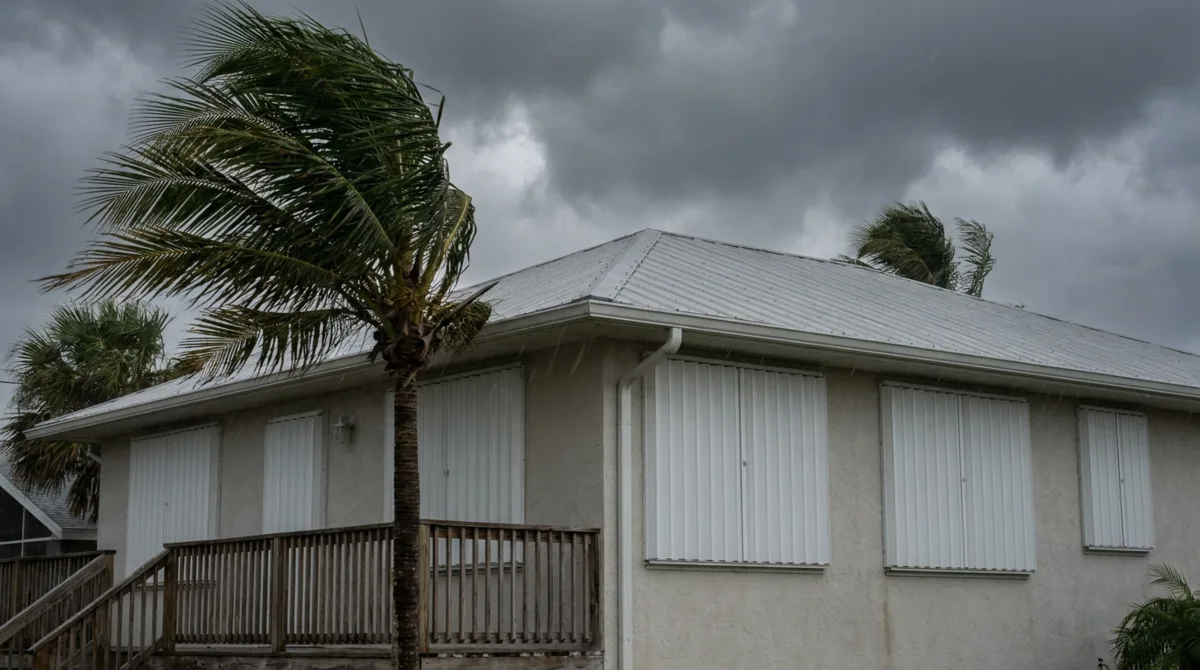
Everyone Waits, and Everyone Regrets It
Season opens June 1 and closes November 30. Anyone who has lived on the Space Coast for a few years knows the pattern: nothing happens, nothing happens, nothing happens, and then a system organizes in the Atlantic and suddenly every roofer from Titusville to Palm Bay has a three-week backlog.
Brevard has had its reminders. Frances and Jeanne came through within three weeks of each other in 2004. Nicole came ashore just south of us in November 2022 and chewed up the beachside dune line. The county sits on a long, exposed stretch of Atlantic coast with a barrier island in front of it, and the mainland side gets its own problems from the Indian River and Banana River when water piles up.
None of that is a reason to panic. It is a reason to do the boring work early.
What Actually Fails
People picture roofs peeling off wholesale. What we see far more often is a small breach that turns into a large bill.
- Garage doors that flex and then let go
- Soffit panels pulling free at the eave
- Drip edge and roof edge lifting
- Older single-hung windows and sliders
- Entry doors with tired weatherstripping
- Loose or cracked roof penetrations
- Clogged gutters and blocked scuppers
- Grading that sends water toward the slab
The sequence that does real damage is almost always the same. Something opens up the building envelope, wind pressurizes the interior, and then the roof structure is fighting from the inside as well as the outside. A garage door is the biggest single opening on most Brevard houses, which is exactly why it deserves attention before a $40 piece of weatherstripping gets treated as the priority.
The Pre-Season Walk
You can do most of this yourself on a Saturday with a ladder and an hour of patience.
Outside. Walk the perimeter and look up. Sagging or separated soffit, loose fascia, lifted shingle tabs at the edges and hips, exposed nail heads, cracked boots at plumbing vents. Check that the gutters actually drain away from the foundation and not into the flower bed against the block. Trim anything overhanging the roof. Live oaks are beautiful and they are also the reason half the roof damage in this county happens.
Openings. If you have shutters, put a set up now rather than discovering in September that the panels for the back slider are missing and the wing nuts are seized. If you have impact glass, find the paperwork with the product approval numbers. You will want it for the wind mitigation form anyway.
Garage. Look for bracing on the inside of the door, check that the track is straight and the rollers are sound, and confirm the door is actually rated rather than assumed to be.
Inside and up. Attic, with a flashlight, on a cool morning. Daylight where there shouldn't be any, staining on the underside of the decking, and whether the trusses are strapped to the top plate or just toe-nailed. That last one is a wind mitigation credit item and it also tells you something honest about how the house will behave.
Document before, not after. Dated photographs of every elevation, the roof, each room, and the mechanical equipment take twenty minutes and they change the character of any future claim conversation entirely. Put them somewhere that is not just your phone.
The Paperwork Half
This is the part that gets skipped, and it's the part we can actually help with.
If your home has never had a wind mitigation inspection, or the last one is aging out of its five-year window, spring is when to handle it. The OIR-B1-1802 documents the features that may reduce your premium: roof geometry, deck attachment, roof-to-wall connections, secondary water resistance, and opening protection. It is $125 on its own, free with any full home inspection, and $250 bundled with a 4-point.
Two practical reasons to do it before June rather than during September:
- Carriers routinely restrict binding and policy changes once a storm is in the forecast cone
- Inspection and contractor availability across Brevard collapses the moment a system is being tracked
A form completed in April is useful all season. A form you tried to order the week a storm formed may not get processed in time to matter.
After a Storm
Safety first, and that isn't a throwaway line. Downed conductors, standing water over unknown ground, compromised structures. Wait for the all-clear before climbing anything.
Then document. Photograph everything before you tarp, move, or clean, because the first thing anyone will ask is what it looked like immediately afterward. Keep receipts for emergency mitigation. Report the loss to your carrier promptly.
Where we fit: we are inspectors, not public adjusters and not contractors. We can go through a house and produce a clear, photographed condition report, which is frequently useful to the people handling your claim. We do not negotiate with carriers, we do not estimate repairs for bidding, and we do not do the work. Anyone who knocks on your door offering all three in one conversation is worth a hard second look.
What This Buys You
Not immunity. A strong enough storm damages well-prepared houses. What preparation buys is smaller failures, faster recovery, better documentation, and a carrier relationship that isn't starting from a deficit.
We inspect throughout Brevard, from Titusville down through Cocoa, Merritt Island, Rockledge, Viera, Melbourne, and Palm Bay, including the beachside communities. Same or next-day scheduling, and reports back within 24 hours. Call 321-722-7321 or request a quote.
Frequently Asked Questions
Get It Done Before June
Wind mitigation $125, 4-point $150, or both together for $250. Full home inspections from $299 include the wind mitigation free. Same or next-day scheduling across Brevard County.