
West of I-95: What New Houses Do
New construction does not fail less than old construction. It fails differently, and almost everything on this list is something that was never finished rather than something that wore out.
Ductwork
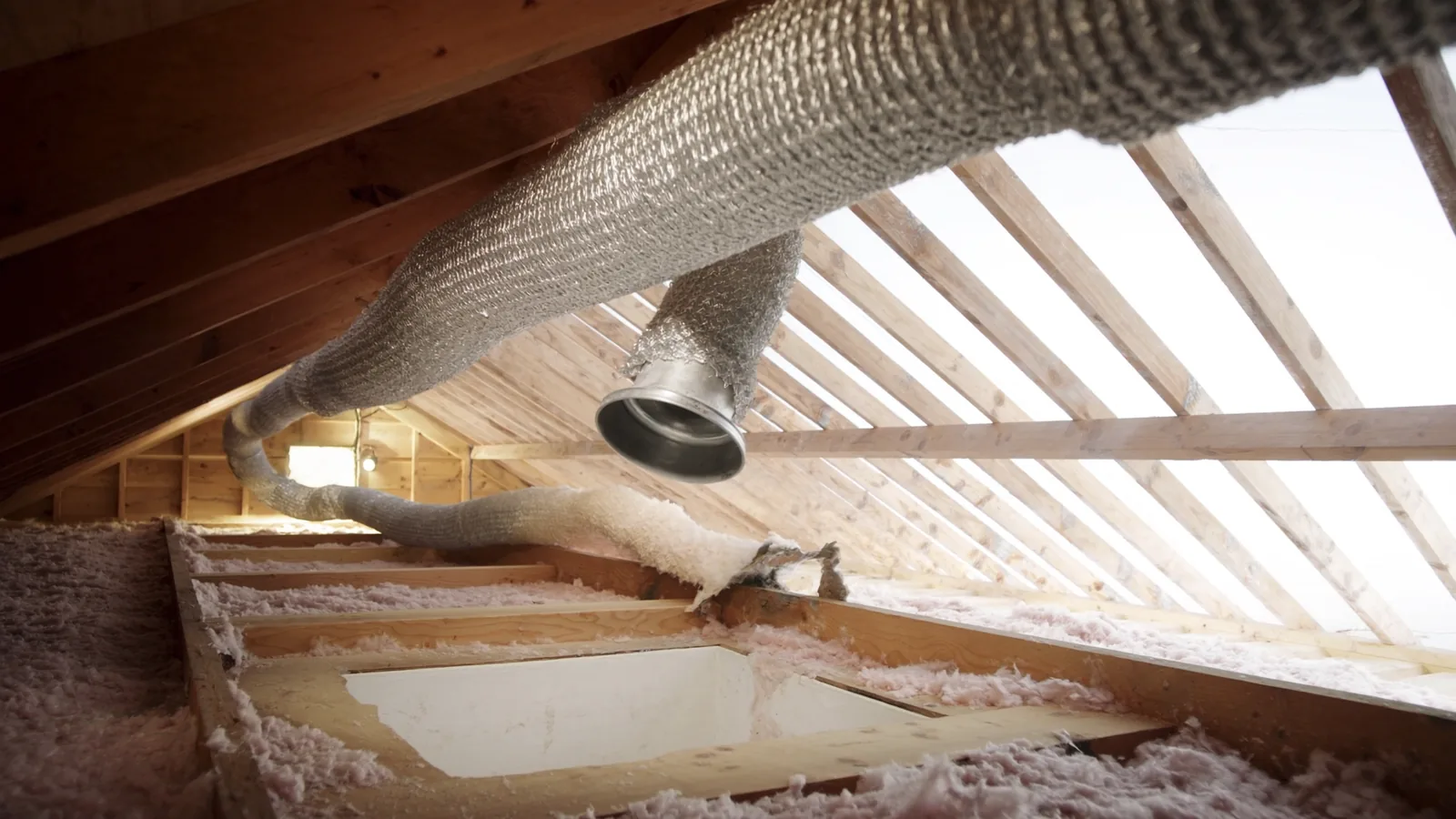
The most common write-up on houses under five years old. A flex run pulled off its boot or crushed against a truss above a ceiling, so one bedroom never cools and the owner spends two summers adjusting a thermostat that was never the problem. It sits in the attic, it takes a few minutes to find, and it is invisible from every room in the house.
Bath Fans Venting Into the Attic
The fan runs, the light comes on, everything appears to work, and the duct discharges into the insulation instead of through the roof. In Florida humidity that produces staining on the underside of the decking within a couple of seasons, and it is the single most common source of a moisture problem in a house too new to have one.
Flashing
Kick-out flashing missing where a roof plane meets a sidewall is a small piece of bent metal that costs almost nothing during construction. Left out, it sends every roof run of water into the wall behind the stucco, and the stain shows up inside two years later when the repair is framing rather than metal. Step flashing done badly at the same junction does the same thing more slowly.
Grading and the Last Ten Feet
Flat lots, sod laid over a grade nobody restored after the trades finished, and downspouts discharging into a bed instead of away from the structure. On new developments built around retention ponds and swales, this is the finding that only proves itself in a real summer downpour.
Every one of the four above lives in the attic or in the first ten feet of soil. That is not a coincidence. It is why an inspection that views the attic from the hatch and assesses the roof from the driveway can hand you a clean-looking report on a house with a two-year water problem already running behind the stucco.
East of I-95: What Older Houses Do
Off Minton Road and toward Melbourne the stock runs 1960s to 1980s, and the list flips from workmanship to age.
Cast Iron Drain Lines
Now past fifty years and at the end of their service life. They corrode from the inside, scale, then crack, and under a slab that is a five-figure repair. Nothing about a house tells you the condition of a pipe buried in concrete. A sewer scope at $265 runs a camera from the house to the municipal connection and answers it directly, which makes it the least popular and most valuable line on the invoice for a house this age.
Panels and Wiring
Original service panels, including makes that some carriers decline to write around, which turns an electrical finding into an insurance problem. Aluminum branch wiring from roughly 1965 to 1975. Missing GFCI protection in kitchens, baths, garages and exterior locations. Double-tapped breakers and open grounds, which are cheap fixes that read badly in volume.
Roof Age
Either replaced once already or overdue, and which one it is decides your insurance quote more than the condition does. Granule loss, lifted or cracked shingles, failed pipe boots, and repairs laid over the top of the original problem rather than through it. The permit date on the replacement is worth digging out before the inspection.
Findings That Show Up on Both Sides
A few things do not care what year the house was built.
Moisture
The one worth understanding properly, because people ask about mold and the useful question is where the water is coming from. An inspection reports elevated readings confirmed with a moisture meter, visible suspected growth, and the condition producing it: the bath fan in the attic, a condensate line leaking into a wall cavity, a failed window seal, grading pushing water back at the slab. Sampling, laboratory work and a written mold assessment are a separate Florida license, held by a mold assessor, and the report names that as the next call rather than pretending to do it.
Wood-Destroying Organisms
Visible damage to wood and the conditions that invite it, such as soil contact, mulch banked against stucco or chronic moisture at a sill, all go in the report. The actual WDO report that a lender or a contract may require comes from a licensed pest control operator, which is a different license from a home inspector's. The licensed inspectors page covers where each one starts and stops.
Slabs and What Cracks Mean
Houses here are slab-on-grade, with no basement and no crawlspace. Hairline cracking is normal as a slab cures and settles, and most of what alarms a buyer is cosmetic. What matters is the pattern, the width, whether there is displacement across it, whether doors and windows have gone out of square, and what the drainage is doing on a flat lot. Where the evidence warrants it, a Florida-licensed professional engineer evaluates it and stamps the answer, and the report says so rather than guessing in either direction.
What This Means for Booking
On a new build, the full inspection with the free wind mitigation report, at month eleven if you are still inside the builder warranty. On an older house, the full inspection with a 4-point at $75 in the same visit and a sewer scope at $265 if there is any chance of cast iron. The whole schedule is on the cost page, the case for each is on the benefits page, and the instant quote tool gives you the exact number. For how we run a home inspection in West Melbourne start to finish, go to the main page.